Choosing an orthopedic implant is not simply a matter of selecting the newest material. It involves bone biology, load, surgical technique, and the patient’s recovery plan. This is why the question “What is the difference between biodegradable and non-biodegradable orthopedic implants” deserves a careful, evidence-based answer.
Biodegradable implants, often made from polymers or magnesium alloys, are designed to provide temporary support and gradually break down. In a successful case, a screw may support a healing fracture, then slowly disappear as new bone gains strength. That sounds ideal. It is not always simple. Degradation can affect mechanical stability, create local by-products, or trigger an unexpected tissue response. Timing matters.
Non-biodegradable implants, including titanium plates and cobalt-chromium components, usually remain in the body and offer predictable long-term strength. They can be valuable when a joint replacement or complex fracture needs durable support. However, permanent hardware may complicate later imaging, revision surgery, or removal. No implant is perfect.
Professor Frank Witte, a recognized researcher in biodegradable magnesium implants, has expressed a central design principle: “The degradation rate should be adapted to the healing process.” That sentence captures the real clinical challenge. The material must not disappear too quickly. It must not remain unnecessarily long, either. Our five tips compare these options through healing time, strength, imaging, complications, and patient-specific factors. Readers should also remember that laboratory performance cannot fully predict a person’s recovery. Surgeons must interpret current evidence alongside X-rays, bone quality, activity level, and medical history.
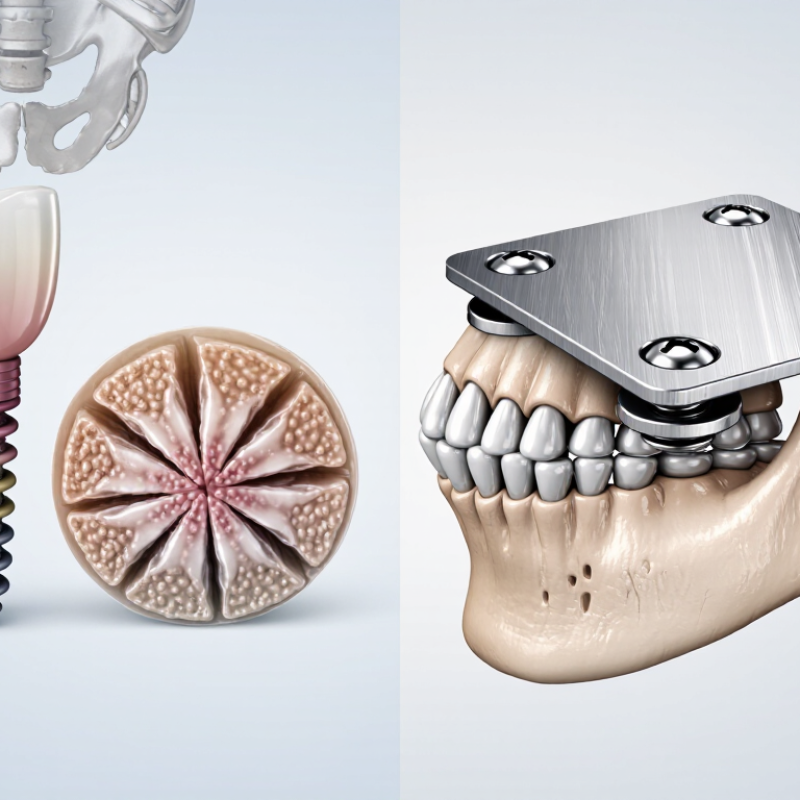
What Are Biodegradable and Nonbiodegradable Orthopedic Implants?
Biodegradable orthopedic implants are designed to support healing and gradually break down inside the body. Common materials include absorbable polymers, magnesium alloys, and certain calcium-based compounds. Their purpose is temporary support. As bone or soft tissue strengthens, the implant may lose its mechanical role. This can reduce the need for a second removal procedure.
Nonbiodegradable implants remain in the body for long-term support. They may use titanium, stainless steel, or specialized ceramics. These materials can provide stable fixation during complex fractures, joint reconstruction, or spinal procedures. However, permanent implants can sometimes cause irritation, stress shielding, infection, or imaging difficulties. The choice depends on anatomy, load, healing ability, and the surgeon’s assessment. The boundary is not always neat. Some “degradable” materials may leave particles or degrade unevenly.
Tip: Ask how long the implant should remain strong. A device that loses strength too quickly may not protect healing bone.
Tip: Discuss imaging and follow-up care before surgery. A small implant may be harder to evaluate than expected. Material performance also varies between patients. Diabetes, smoking, poor circulation, and osteoporosis can change healing patterns. A biodegradable option may sound gentler, but it is not automatically safer. Nonbiodegradable fixation may be more practical when heavy, continuous loading is expected. Surgeons should explain possible complications, removal needs, and the evidence supporting each material. Some clinical decisions remain uncertain, and careful monitoring matters.
Biodegradable vs. Nonbiodegradable Orthopedic Implants
The chart shows typical time to substantial resorption for commonly used biodegradable implant materials. Values are representative literature-based ranges expressed as approximate midpoints and can vary with implant size, location, formulation, and patient factors.
- Biodegradable materials: PGA generally resorbs within about 6–12 months, PLA within 12–24 months, PCL over approximately 24–36 months, and magnesium varies widely, often around 6–24 months.
- Nonbiodegradable materials: titanium, stainless steel, and PEEK are designed to remain in the body unless removed; therefore, they have no expected resorption time.
- Material selection should consider required mechanical strength, healing time, imaging needs, degradation by-products, and the possibility of revision surgery.
How Biodegradable Implants Work and Gradually Resorb
Biodegradable orthopedic implants are designed to support healing, then gradually disappear. Their polymers or magnesium-based alloys interact with body fluids through hydrolysis or controlled corrosion. The material loses strength as new bone gains stability. A 2023 systematic review in the Journal of Orthopaedic Translation reported highly variable magnesium degradation rates, often influenced by alloy composition, surface treatment, and implant shape.
The process is not instant. Water enters polymer chains, while magnesium can release ions and hydrogen gas during corrosion. Surgeons therefore match degradation speed with the expected healing timeline. A small fixation screw may need months of support. Its later resorption can reduce long-term hardware irritation and avoid a second removal procedure. The U.S. Food and Drug Administration emphasizes material characterization, degradation products, mechanical performance, and biological safety before clinical use.
Clinical outcomes still depend on more than resorption. Implant placement, bone quality, loading, and patient activity matter. A 2024 market analysis by Grand View Research estimated the global orthopedic implants market at over USD 45 billion in 2023, showing strong demand for fixation technologies, but market growth does not prove clinical superiority. Some biodegradable devices lose strength too early. Others resorb unevenly. That uncomfortable gap deserves honest follow-up. Close imaging and scheduled review remain essential.
How Nonbiodegradable Implants Provide Long-Term Structural Support
When a bone needs stable support, a nonbiodegradable implant can act like an internal scaffold that remains after healing. Its strength does not depend on gradual breakdown, so alignment may stay protected during slow bone remodeling. This matters in load-bearing areas, where walking can create repeated stress. Surgeons assess bone quality, fracture pattern, activity level, and expected healing time before choosing material. A durable implant is not automatically the best implant. That distinction is easy to miss.
Five practical checks help guide the discussion: mechanical strength, tissue compatibility, imaging needs, fixation method, and future removal. Materials such as titanium alloys, stainless steel, and certain polymers have different stiffness and imaging behaviors. A mismatch can concentrate stress near the implant or make follow-up images harder to interpret. Placement also matters; a well-designed device can fail if fixation is poor or loading begins too early. Healing takes time. Rehabilitation should match the implant’s role, not merely the calendar.
Long-term support can be valuable when healing is uncertain, but permanence brings trade-offs. Some patients may experience irritation, infection, loosening, or stress shielding, and removal may require another procedure. Evidence must be read carefully because outcomes vary with anatomy, surgical technique, and patient health. I would not treat “permanent” as “maintenance-free.” Follow-up examinations and imaging remain important, even when pain improves. The honest question is whether lasting support fits this patient’s biology and daily demands.
Key Differences in Materials, Healing, and Clinical Applications
Biodegradable and nonbiodegradable orthopedic implants differ mainly in material behavior, healing support, and long-term management. Biodegradable polymers may gradually break down into smaller compounds, while magnesium-based devices can slowly dissolve under controlled conditions. Titanium and stainless steel usually remain stable for many years. PEEK also resists biological breakdown and can reduce imaging artifacts.
Tip 1: Match the implant to mechanical demand. High-load areas may need lasting structural support.
Tip 2: Check degradation timing. An implant that disappears too early may weaken healing tissue. One that remains too long may cause irritation or complicate revision surgery. Healing is not identical for every patient. Bone quality, age, smoking, infection risk, and nutrition can change the result.
Tip 3: Consider tissue response. Some biodegradable materials can create acidic byproducts or local inflammation during breakdown.
Tip 4: Plan imaging carefully. Metal can obscure nearby anatomy, while radiolucent materials may improve follow-up visibility.
Tip 5: Discuss removal before surgery. A stable implant may avoid another operation, but it can remain a lifelong foreign body. Biodegradable devices may reduce removal procedures, although their evidence varies by site and design. Clinical decisions should rely on peer-reviewed data, imaging, and the surgeon’s experience with comparable injuries. Material choice is rarely perfect. Follow-up remains essential, even when the implant is designed to disappear.
How to Choose Between Biodegradable and Nonbiodegradable Implants
How to Choose Between Biodegradable and Nonbiodegradable Implants
Choosing an orthopedic implant starts with the healing timeline, not marketing language. Biodegradable screws, often made from polymers or magnesium alloys, gradually break down after supporting bone. Nonbiodegradable implants, commonly titanium or stainless steel, maintain strength for longer periods. Fit matters. The American Academy of Orthopaedic Surgeons emphasizes fixation stability, patient health, and procedure-specific evidence when selecting implant materials.
Consider five practical questions. Will the implant face heavy or repeated loading? Is a second operation likely? Could future imaging be important? How quickly must the device lose strength? Does the patient have diabetes, poor bone quality, or an allergy history? A 2023 systematic review in Injury reported promising clinical outcomes for magnesium-based fixation, but also noted limited long-term evidence and variable degradation rates. That uncertainty deserves attention.
Nonbiodegradable devices offer predictable mechanical support and extensive clinical experience. However, they can create imaging artifacts or require later removal when irritation develops. Biodegradable devices may reduce removal procedures, yet degradation can cause local inflammation, fluid pockets, or premature loss of support. A 2024 market analysis by Grand View Research projected continued growth in biodegradable orthopedic materials, but market growth does not equal clinical superiority. I would ask for comparative human data, regulatory clearance, and the surgeon’s experience with the exact implant. Evidence can still be incomplete. Patient-specific planning remains safer than choosing by material alone.
5 Tips: Biodegradable vs Nonbiodegradable Orthopedic Implants — How to Choose
| Tip |
Decision Factor |
Biodegradable Implants |
Nonbiodegradable Implants |
Practical Selection Guidance |
| 1 |
Required mechanical support |
Common materials include polymers such as PLLA, PGA, PLGA, and PCL, as well as selected magnesium-based materials. Strength and stiffness generally decrease as degradation progresses.
|
Titanium, stainless steel, and cobalt-chromium alloys can provide durable mechanical fixation and are available in a wide range of strengths and designs.
|
Choose a biodegradable option only when the implant can maintain stability during the expected healing period. Use a permanent implant when long-term load-bearing support is essential.
|
| 2 |
Expected degradation or removal |
Designed to gradually break down and be absorbed or cleared by the body. Degradation may take months to several years, depending on material, size, location, and patient factors.
|
Typically remains in the body unless removed surgically. Removal may be considered when the implant causes symptoms, interferes with function, or is no longer clinically necessary.
|
Consider biodegradable fixation when avoiding a second removal procedure is clinically important and the material’s degradation profile matches the healing timeline.
|
| 3 |
Imaging and follow-up |
Many polymer implants are radiolucent and may be difficult to see directly on standard X-rays. Some designs include radiopaque markers; imaging follow-up may rely on bone healing and implant position.
|
Metal implants are usually visible on X-rays and may create imaging artifacts. Titanium generally produces less magnetic-resonance artifact than stainless steel, although artifact depends on implant design and imaging parameters.
|
Select the material according to the need for direct visualization, MRI or CT follow-up, and the anatomical region being treated.
|
| 4 |
Biological response and complications |
Degradation can produce local by-products. Polymer implants may be associated with swelling, sterile inflammatory reactions, delayed degradation, or incomplete resorption. Magnesium-based materials may release hydrogen gas during corrosion.
|
Possible concerns include infection, allergic or hypersensitivity reactions, corrosion or wear, stress shielding, loosening, and irritation of nearby soft tissue.
|
Review allergy history, bone quality, soft-tissue coverage, infection risk, and the implant’s known biological response before choosing the material.
|
| 5 |
Patient, procedure, and evidence fit |
May be suitable for selected sports injuries, pediatric cases, small-fragment fixation, and procedures where temporary support is appropriate. Clinical evidence varies by material, anatomy, and indication.
|
Often preferred for fractures or reconstructions requiring predictable, durable fixation, including situations involving high loads, poor bone quality, or complex mechanical demands.
|
Base the final choice on anatomy, loading conditions, healing potential, patient age, activity level, surgeon experience, regulatory clearance, and high-quality clinical evidence.
|
Important note: Biodegradation time, mechanical performance, imaging visibility, and complication rates vary substantially by material formulation, implant size, design, surgical technique, anatomical site, and patient condition. Final implant selection should be made by a qualified orthopedic professional using procedure-specific clinical evidence.
Conclusion
Biodegradable and nonbiodegradable orthopedic implants are designed to support bone healing, but they behave differently after implantation. Biodegradable implants are commonly made from materials that gradually break down and are absorbed or eliminated by the body. As healing progresses, they can reduce the need for later removal surgery, although their strength may decrease over time. Nonbiodegradable implants, often made from durable materials, remain in place and provide long-term structural stability when continuous support is necessary.
What is the difference between biodegradable and non-biodegradable orthopedic implants? The main differences involve material composition, mechanical durability, healing strategy, and clinical use. Biodegradable options may be suitable when temporary fixation is preferred and natural tissue repair can gradually take over. Nonbiodegradable implants may be better for complex fractures, joint reconstruction, or situations requiring lasting reinforcement. Choosing between them depends on the patient’s age, bone quality, injury type, expected healing, implant location, and the surgeon’s clinical judgment.

 Marin-one Medical