Before a hospital approves an orthopedic implant, durability testing should examine more than packaging and purchase price. Why is it important to test orthopedic implants for durability before purchase? Because a polished surface can hide fatigue, wear, loosening, or breakage risks. These problems may appear after thousands of walking cycles, not during a short product demonstration.
The UK National Joint Registry’s 21st Annual Report and the Australian Orthopaedic Association National Joint Replacement Registry show why long-term evidence matters. Both registries track revision surgery across millions of joint replacements. Their findings demonstrate that implant performance varies by design, fixation method, patient factors, and time. Even a small difference in revision risk can affect many patients. Pain, reduced mobility, and another operation are not minor purchasing issues.
Durability needs evidence.
Professor Henrik Malchau, a leading joint-replacement researcher, has stated, “The only way to know if an implant works is to follow it over time.” This principle should guide procurement teams. Laboratory tests should include cyclic loading, corrosion exposure, wear simulation, fixation strength, and failure analysis. Results should be compared with published clinical data, not isolated marketing claims.
A careful buyer should also review independent registry outcomes, recall history, and post-market surveillance. Testing cannot predict every patient experience. That limitation deserves honesty. Still, it can reveal warning signs before surgeons place the device in a real human body. A transparent durability review protects budgets, clinicians, and most importantly, patients who expect one operation to last.
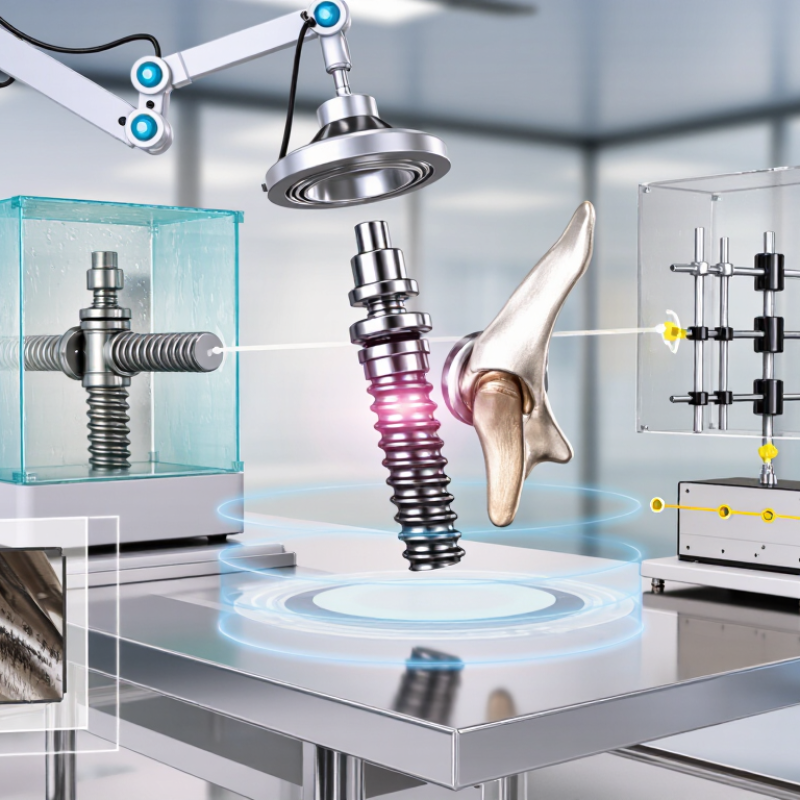
Orthopedic implant durability means more than surviving a laboratory load cycle. It includes wear resistance, fatigue strength, fixation stability, and corrosion behavior. These factors influence pain, mobility, revision risk, and rehabilitation time. Clinical durability is never purely mechanical.
The AOANJRR 2024 Annual Report analyzed more than two million hip and knee replacement procedures. Its registry data shows that revision risk varies with patient age, diagnosis, fixation method, and implant design. The UK National Joint Registry’s 21st Annual Report also demonstrates that long-term outcomes differ across procedure types and patient groups. A ten-year survival figure is useful, but it cannot predict every patient’s experience.
Testing before purchase should connect bench evidence with clinical evidence. Fatigue testing can reproduce repeated walking loads. Wear testing can measure debris generation under controlled motion. Microscopy may reveal surface damage that ordinary inspection misses. ISO 7206 and ISO 14242 methods provide recognized frameworks for hip implant evaluation. However, standards do not eliminate uncertainty.
Real patients are less predictable.
A responsible review should examine sample size, testing duration, failure definitions, and post-market surveillance. It should also ask whether the tested design matches the intended anatomy and activity level. One weakness is often overlooked: laboratory conditions may not represent obesity, poor bone quality, falls, or high-impact movement. Durability claims therefore need cautious interpretation. The strongest purchasing decision combines independent test results, registry evidence, surgeon experience, and transparent limitations.
Material selection strongly influences implant longevity. Titanium alloys offer favorable strength and biocompatibility, but surface damage can accelerate wear. Cobalt-chromium alloys resist deformation under heavy loads. Ceramic components produce low friction, yet they require careful impact testing. Highly cross-linked polyethylene can reduce debris generation, although oxidation remains a concern. Small details matter.
Design determines how materials perform inside the body. A polished surface may reduce friction, while poor geometry can concentrate stress around fixation points. Porous coatings can improve bone integration, but pore size and coating adhesion need verification. Fatigue testing should simulate millions of walking cycles, not only one-time loading. Real patients twist, stumble, and carry uneven loads. Laboratory testing can miss that.
Registry data supports cautious evaluation. The Australian Orthopaedic Association National Joint Replacement Registry Annual Report 2024 shows that revision risk varies by joint, fixation method, patient age, and implant combination. The UK National Joint Registry 21st Annual Report also reports meaningful differences in long-term revision outcomes across implant designs. These reports do not predict every patient’s result. They reveal patterns worth investigating. Pre-purchase testing should therefore examine wear, corrosion, fatigue, fixation, and manufacturing consistency. I would also question impressive short-term results. Five years can look excellent. Twenty years may tell another story.
Orthopedic implant durability testing should happen before purchase, not after a failure raises concern. Fatigue testing applies repeated loads that simulate walking, climbing stairs, or lifting. It can reveal cracks invisible during a basic inspection. Static testing measures the force an implant withstands before permanent deformation. Both tests should reflect the intended body location and patient activity.
Wear testing is essential for joint components with repeated contact. Engineers measure material loss, surface damage, and released particles over time. Corrosion testing examines how body fluids may affect metals or coatings.
Impact testing adds another practical question: can the implant tolerate a sudden load? Test reports should identify methods, sample sizes, loading cycles, and acceptance criteria. Independent laboratory review adds confidence.
Still, no laboratory model perfectly represents every patient. That limitation deserves attention.
Tips: Request complete durability reports, not only passing statements. Check whether fatigue, wear, corrosion, and impact tests match the implant’s clinical use. Review results against recognized medical-device standards and applicable regulatory requirements. Ask how manufacturing variations were controlled. A polished report can still hide weak sampling. Keep questions in writing, and have a qualified orthopedic specialist or biomedical engineer review uncertain findings. Real-world performance depends on surgical technique, anatomy, activity, and long-term follow-up.
Orthopedic implant durability testing supports safer purchasing decisions because laboratory evidence reveals failure risks before clinical use. Engineers examine wear, fatigue, corrosion, loosening, and repeated loading. A hip component may face millions of simulated walking cycles. The result is not a guarantee. It is useful evidence.
The UK National Joint Registry’s 21st Annual Report (2024) tracks more than four million joint replacement procedures. Its findings show that revision risk varies with implant design, fixation method, patient age, and sex. The Australian Orthopaedic Association National Joint Replacement Registry’s 2024 report also demonstrates differences in revision outcomes across designs and surgical factors. These reports help procurement teams compare test results with real-world performance. They also support regulatory submissions by linking bench data, clinical evidence, and risk controls. FDA guidance expects manufacturers to explain device safety and performance using appropriate evidence. Poorly connected evidence can weaken a submission.
Tips: Ask for fatigue-test conditions, sample sizes, failure definitions, and raw summaries. Check whether testing reflects body weight, motion, and sterilization. Compare results with registry data, not marketing claims. No bench test predicts every patient. That limitation matters. Testing may also miss rare corrosion patterns or unusual surgical technique. A careful review records these gaps instead of hiding them. This approach supports safer selection, clearer regulatory discussions, and more realistic expectations after purchase.
| Durability Test Area | Relevant Standard or Framework | Typical Measurements | Safety and Performance Value | Purchase or Regulatory Decision Supported |
|---|---|---|---|---|
| Static strength | Applicable device-specific ASTM or ISO methods, such as ASTM F382 for metallic bone plates | Ultimate load, yield load, stiffness, displacement, and permanent deformation | Shows whether the implant can tolerate expected single-event loads without excessive deformation or sudden failure. | Screens out designs with inadequate mechanical reserve and supports performance claims based on defined loading conditions. |
| Cyclic fatigue | Device-specific fatigue methods; examples include ASTM F1717 for spinal implant constructs and ISO 7206-4 for hip stems | Load level, cycle count, crack initiation, fracture location, and run-out status | Addresses repeated loading that may cause fatigue cracking or failure during long-term use. | Provides evidence for expected service-life evaluation, design comparison, and risk-control verification. |
| Wear and particle generation | ISO 14242 series for hip-joint prosthesis wear and ISO 14243 series for knee-joint prosthesis wear, where applicable | Gravimetric wear, wear rate, surface damage, particle characteristics, and lubricant changes | Helps assess material loss, debris generation, and changes in bearing performance under simulated use. | Supports material selection, design verification, biological risk assessment, and technical documentation. |
| Corrosion and fretting resistance | ASTM F2129 and other applicable electrochemical or fretting-corrosion methods | Corrosion potential, corrosion current, surface damage, metal release, and visual changes | Examines degradation risks in physiological environments, particularly at modular or contacting interfaces. | Supports materials assessment, interface design decisions, and chemical or biological safety evaluations. |
| Fixation and interface stability | Applicable methods such as ASTM F543 for metallic medical bone screws | Insertion torque, removal torque, pullout strength, torsional strength, and cyclic performance | Indicates whether fixation components can be inserted, retained, and loaded without stripping or loosening beyond defined limits. | Helps compare implant configurations and confirms compatibility with the intended surgical technique. |
| Material and surface integrity | Applicable material, coating, surface-finish, and cleanliness specifications | Dimensional change, coating adhesion, roughness, defects, cracks, contamination, and post-test inspection findings | Confirms that manufacturing and finishing processes do not introduce defects that could reduce strength or increase biological risk. | Supports supplier qualification, incoming inspection plans, and manufacturing-process validation. |
| Environmental and sterilization effects | Validated sterilization, packaging, aging, and conditioning procedures applicable to the device | Mechanical performance before and after conditioning, packaging integrity, seal integrity, and visible degradation | Determines whether storage, transport, and sterilization conditions alter implant strength or surface quality. | Supports shelf-life claims, packaging approval, receiving requirements, and change-control decisions. |
| Test-method validity and traceability | ISO/IEC 17025 laboratory competence principles and a documented, device-specific test protocol | Calibration records, specimen traceability, sample size, acceptance criteria, deviations, raw data, and failure analysis | Improves confidence that results are reliable, reproducible, and relevant to the intended use. | Supports supplier audits, quality agreements, regulatory submissions, and defensible purchasing decisions. |
Note: The applicable standard, loading profile, acceptance criteria, sample size, and test environment should be selected according to the implant type, intended use, materials, fixation method, and applicable regulatory requirements.
Orthopedic implant durability should be compared through evidence, not confident marketing language. A reliable review begins with fatigue-test results, wear rates, corrosion resistance, and fixation strength. These measurements show how an implant may respond to repeated loading inside the body.
Look closely at testing conditions. Ask how many loading cycles were completed, which materials were tested, and whether the environment matched body temperature and fluid exposure. A polished implant may perform well in a dry laboratory but behave differently when surrounded by biological fluids. Small differences matter. A lower wear volume can reduce debris, while stronger fixation may support earlier movement. However, no single number proves long-term success.
Independent laboratory reports and peer-reviewed studies deserve greater weight than isolated internal claims. Compare testing methods, sample sizes, failure definitions, and follow-up periods. Clinical data can reveal loosening, fracture, revision rates, and patient-reported function over time. Still, these studies are rarely perfect. Patient age, bone quality, surgical technique, and activity levels can distort comparisons. I have seen durability tables appear impressive until the testing protocols were examined closely. That is why buyers should record each result in the same format and question missing details. A dependable choice usually comes from consistent evidence across laboratory testing and real clinical experience, not from the highest headline figure.
Comparing long-term revision-free survival data helps assess durability, but results also depend on patient age, activity level, surgical technique, implant alignment, fixation, and follow-up duration.
The chart shows pooled revision-free survival estimates reported in systematic reviews of total hip and total knee replacements. These population-level results are not head-to-head comparisons of individual implants and should be used alongside mechanical testing, regulatory documentation, clinical evidence, and patient-specific factors.
Source: Evans JT et al., systematic reviews and meta-analyses of long-term total hip and total knee replacement survivorship, published in The Lancet.
Titanium alloys combine strength with good biocompatibility. Cobalt-chromium alloys resist deformation under heavy loads. Ceramics reduce friction but need careful impact testing. No material is perfect.
Poor geometry can concentrate stress near fixation points. Polished surfaces may reduce friction. Porous coatings can support bone integration, but pore size and adhesion require verification. Small details can become large problems.
Request fatigue, wear, corrosion, impact, and static-load testing. Fatigue tests should simulate millions of walking cycles. They should also include stairs, lifting, and uneven loading. One load is not enough.
Repeated loading can expose cracks that a basic inspection misses. Testing should match the implant’s body location and intended activity. A patient may twist, stumble, or carry weight unevenly. Laboratory models remain imperfect.
Check material loss, surface damage, and released particles during wear testing. Corrosion testing should reflect body fluids and temperature. Ask whether the test environment resembles actual implantation conditions. Dry results may mislead.
The report should identify methods, sample sizes, loading cycles, and acceptance criteria. It should explain failure definitions and test conditions. Independent laboratory review adds confidence. Passing language alone proves little.
Record fatigue strength, wear volume, corrosion resistance, and fixation results in one format. Compare materials, cycles, sample sizes, and follow-up periods. Do not trust the highest headline number. Missing details matter.
Review loosening, fracture, revision rates, and patient-reported function over time. Registry patterns can reveal differences by joint, fixation method, age, and implant combination. They cannot predict every patient’s result. Five years may look excellent, while twenty years tells another story.
Orthopedic implant durability is a critical factor in protecting patient safety, supporting reliable clinical outcomes, and controlling long-term healthcare costs. Why is it important to test orthopedic implants for durability before purchase? Implants must withstand repeated loading, friction, corrosion, and changing biological conditions without excessive wear, deformation, or structural failure. Their longevity depends on material quality, surface treatment, geometry, fixation method, and overall design compatibility with the intended anatomical application.
Before selecting an implant, purchasers should review essential evidence from fatigue, wear, corrosion, tensile, impact, and simulated-use testing. These results help determine whether the device can maintain strength and performance throughout its expected service life. Comparing test methods, loading conditions, failure thresholds, and documented results enables hospitals and clinical teams to identify the most reliable option rather than relying only on price or marketing claims. A thorough durability assessment also supports risk management, procurement decisions, regulatory review, and informed discussions about patient care.

Marin-one Medical